The Ninth Sunday after Pentecost

July 26, 2026
During our summer season this year, Celebration Circle has invited us to share from our personal faith journeys, reflecting on what initially drew us to Seekers, and how that has affected our spiritual journey since then.
That’s a challenging invitation for me. I’ve been part of Seekers Church for 50 years, so there are a lot of memories, more than I have the energy to share – or you have the interest to hear. What I’m ready to share today are a few reflections that seem relevant to where we are right now as a family of faith.
This is a time of change and growth for Seekers Church. We are approaching our 50th anniversary as a distinct congregation. Last month we marked the 22nd year in our own space. There are lots of conversations being coordinated for us by the Weave Team, re-evaluating who we are in the midst of lots of turbulence, including reconstruction of the neighborhood right around us in the midst of our argumentative city and the chaotic world.
So… looking back half a century, what brought me to Seekers Church, and what difference does it make? Here are a few reflections.
What brought me to Seekers Church? The short answer is the idea of ministry in daily life, supported by “mission groups” of the church.
I first heard about the idea of mission groups in the 1960s. At that time I was an Army officer, teaching ROTC at Dartmouth College. I was assigned there after serving a year in Viet Nam as the American advisor to a county of 90,000 people, helping the people of Duc Pho District them rebuild housing and community services to sustain community life while surrounded by the guerillas. My Viet Nam experience felt to me like trying to do the work of the Peace Corps in the midst of a war.
When I arrived in Hanover in the Spring of 1968, the level of anti-war protest was high on the Dartmouth campus. The local chapter of the Students for a Democratic Society (SDS) was holding demonstrations and vigils protesting the war. They had an office on campus, on the floor just below the ROTC offices. We saw each other frequently but didn’t have much contact. I knew about that war first-hand, and wanted it to end, but I had also experienced the oppressive conditions in Viet Nam and wanted to find a path to a JUST peace.
Meanwhile, as members of the Church of Christ at Dartmouth College, Marjory and I had found a welcoming, inclusive congregation. Through the Church we had the opportunity to join a group that staffed the Ram’s Horn coffee house, a campus ministry just down the block from my office. The Ram’s Horn was consciously patterned on the Potter’s House, founded in 1960 by Church of the Saviour in Washington, DC. Like the Potter’s House, the Ram’s Horn was envisioned as a safe place for community conversation.
So, on Friday nights I took off my uniform, put on a black turtleneck and served coffee, free popcorn and snacks to folks who came to the Ram’s Horn to share their lives with friends. I had opportunities to be welcoming, and I learned a bit about listening more deeply without setting the agenda or trying to convert others to my way of thinking
Our Friday night team met for prayer and sharing before the doors opened for business, then worked the evening serving those who came, and cleaned up after closing. It was a rich and full experience, and my first encounter with life in a mission group. It gave me a few opportunities to meet my office neighbors from SDS and begin to get beneath my stereotypes.
Being committed to the Friday night team gave me a place to share my questions and fears as well as the satisfaction of working together. Being part of a group working to maintain a welcoming and inclusive environment where folks who shared common values but were on different paths helped me feel grounded for the short time I was in Hanover.
When Dartmouth closed the ROTC program in 1969 the Army sent me back to Viet Nam. Although the Church was clearly opposed to the war, they blessed me with a commission to work for peace and justice while I was there. They appointed a companion to stay in touch with me while I was away. One vivid memory of that connection came a couple months after I began “long-range” planning for the 101st Airborne Division. One day I received a small package in the mail, sent by my companion from the Church! In the greasy box was one of my favorite treats from the Ram’s Horn, a collection of popcorn left over from the baskets we kept full on every table. Most of the kernels had only partially popped and were salty but so tough that I didn’t risk my teeth to enjoy them. But that quiet memory sent by the Friday Ram’s Horn Team reminded me that they were holding me in prayer as I discerned how to work for peace and justice in a place of violence and combat.
My sense of being called to work for peace and justice where I’ve been sent resonated with Seekers’ early commitment to support for family and vocation as ministry. Our understanding that the “outer journey “can be expressed through our places of work.
Seekers helped me find and claim the story embedded in the letter sent by the prophet Jeremiah to the exiles carried off into Babylon in the great exile in about 600 BCE. One of Jeremiah’s letters to the Jewish community living through this displacement, is recorded in the Book if Jeremiah, Chapter 29. Part of it says:
This is what the Lord Almighty, the God of Israel, says to all those I carried into exile from Jerusalem to Babylon: “Build houses and settle down; plant gardens and eat what they produce. Marry and have sons and daughters; find wives for your sons and give your daughters in marriage, so that they too may have sons and daughters. Increase in number there; do not decrease. Also, seek the peace and prosperity of the city to which I have carried you into exile. Pray to the Lord for it, because if it prospers, you too will prosper.” — Jeremiah 29:4-8
In other words, work for peace and justice where you are.” When I came to Seekers I had just been assigned by the Army to a small team in the Office of the Secretary of Defense, watching the strategic balance between NATO and the Warsaw Pact. It felt like a place where I could “… seek the peace and prosperity of the city to which I have carried you into exile.” Seekers was a community that was able to welcome me and support my work in the world as ministry in daily life.
So, when I think back to the mid-seventies and consider what drew me in, one of the key elements was our commitment to support ministry in daily life as an important expression of the outer journey, then AND now!
Let me turn to the second element of the invitation from Celebration Circle: How has being part of Seekers Church affected your spiritual journey?
Here, what comes to mind is the many ways our commitment to shared leadership encourages spiritual and relational growth, offering evolving opportunities for service and sources of support. When I came to Seekers I was deeply submerged in outside work and saw Seekers as a source of support. Soon I felt a call to help support our adult education program and joined the Church of the Saviour mission group that supported the Tuesday night school of Christian living. When Seekers emerged as a separate family of faith and all of the members of that mission group were Seekers, that mission group became accountable to Seekers Church while continuing to serve people from all CofS communities.
After two years away, from 1980 to 1982, for my final Army active-duty assignment, I returned to regular participation with Seekers, and soon felt called to Celebration Circle, where I have served in different roles for over 40 years! That commitment includes helping write our liturgies, design and produce bulletin covers and altar installations and serve as liturgist and leader for our weekly gathering time. It has been a rich and full learning opportunity, and nurtured my inner creativity!
When Seekers established our Servant Leadership Team in 1989, I felt a call to offer my service there, seeing my role as a helper through a time of transition. Over the next 25 years we lived through a lot of changes as a community while I served on the SLT.
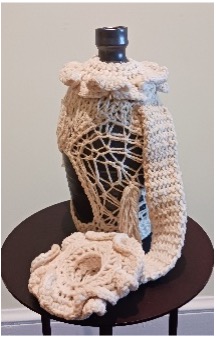
Through it all, this community has been a nursery of creativity for me. The descriptive mantra in the front window says we aspire to ne creative and inclusive. I’ve felt that from the beginning. When little seeds of creativity have fallen from me here, they have landed on fertile ground. I grew up feeling that I didn’t fit in; that I needed to do what the other guys did in order to fit in, or stay in the “back office,” to keep things working. That’s been appreciated, and I’m always grateful. But Seekers has made a place for some of those seeds of creativity in ways that encourage me to keep playing. This morning I’ve put a couple reminders of that on the altar table.
The first is a crocheted dressing for one of Marjory’s ceramic jars. “Bashful Brown Bottle” sits on my dresser at home, reminding me that there’s often some playful wildness buried in ordinary places.

The chasuble is an 11-level labyrinth. And the other reminder is a little book of my poems. I pulled together “Fleeting Glimpses” about 15 years ago from writing since I came to Seekers. The first poem, written as I was finding my roots speaks to how Seekers has helped me know I belong in this family of faith.
I Do Not Fit
I do not fit. I never have.
But then, it may not be my call
to find some pleasant spot
where all the inputs and the processes of life
seem known, unchanging
and immutable.
For life is change for me.
To grow means being different tomorrow
than I am today.
And every living thing that stops its growth
begins the quiet process of decay.
I see them all about me,
these comfortable, decaying souls,
who know exactly what tomorrow brings –
more of today.
I often long to share their lot.
Yet somewhere deep inside
there is a Spirit pushing, drawing,
leading me to look
where I have never looked before;
to ask the questions that I know
will stir things up;
to feel the anger, joy and pain
of new realities.
I have some friends who care about me very much,
who share my anger and my joy
as I share theirs.
They don’t fit in. They never will.
And my relationship to them
will never be the same tomorrow as it is today.ca 1978
Our “way” as a faith community takes time to understand and explain. But it gives us opportunities to develop and offer our gifts in a supportive environment. And, as calls grow over time, individuals grow, and change, and move into new roles. It feels to me like an example of becoming a different part of a growing body, like an undifferentiated cell growing into a particular kind of cell to meet a current need – a kind of stem cell in the Body of Christ.
So, in closing, here are a couple of thoughts I’d offer from my journey with Seekers Church.
- What drew me to Seekers was the commitment to honor and support ministry in daily life as a valid call wherever you are sent, and to support Seekers who respond to that call; and
- My journey as a committed member of Seekers Church for almost 50 years has given me countless opportunities to offer my gifts in different still emerging ways.
I have learned a lot, and still see opportunities to learn more now. As I recognize that I’m slowing down, I need to learn how to act my age: to limit my commitments to what I can handle; to ask for help when I don’t understand, and to learn how to share with those around me the thanks I experience in my heart for all of you as we make our way down the road together.
Keep praying!