The Fourth Sunday in Advent
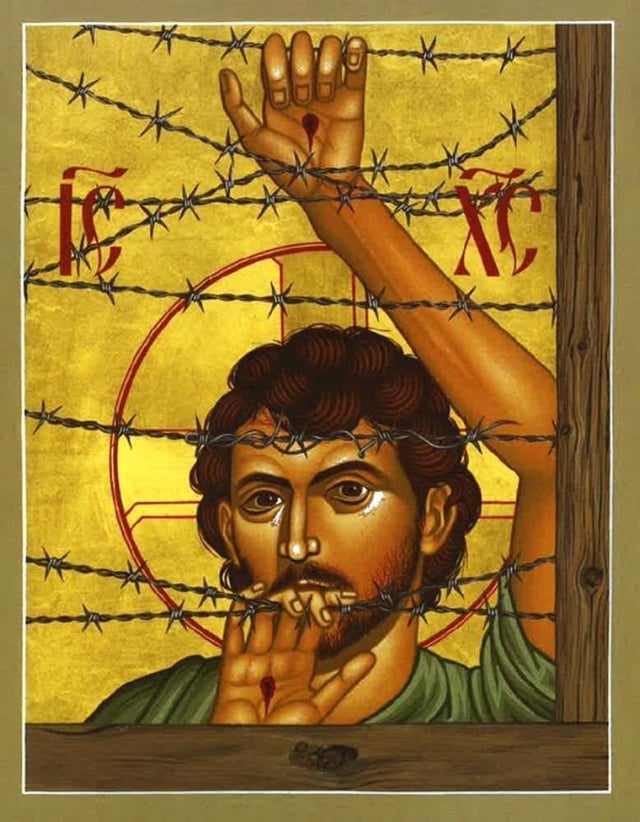
December 21, 2025
Sallie and Lucy brought their thoughts and insights from a recent book study of Christ in the Rubble, by Rev. Dr. Munther Isaac, the Palestinian pastor of Christmas Lutheran Church in Bethlehem.
Sally began by quoting Jan Richardson, who wrote…
Blessed are you Who bear the light In unbearable times…
(Blessed are you In whom The light lives…)
She continued
I’ve always loved the Christmas holidays. I love the tree, the lights, the music, the decorations, and the nativity scene. As I sat among those things writing this sermon, the disparities between this holiday joy and our worldly catastrophes is heart wrenching. I can’t help but wonder, have I been sweet-washing Christmas? Once again, this year Christmas will be celebrated amidst the cries of violence, tragedy, detentions, deportations and genocide.
Unbearable times…
I’ve been struggling with how the nativity story, set against the backdrop of the genocide in Gaza, changes the meaning of Christmas. The Nativity story takes on a more urgent meaning, shifting Christmas from a purely joyful holiday to a profound reflection on displacement, injustice, and the suffering of the innocent. For me, Mary and Joseph’s journey from Nazareth to Bethlehem is powerfully linked to the forced displacement of Palestinians in Gaza, who have been compelled to flee their homes to escape violence, often multiple times.
According to Munther Issac, who wrote Christ in the Rubble, the manger is a powerful symbol of Solidarity. I want to pause here to say a word about Solidarity.
The manger of solidarity nativity recreated in Bethlehem’s Evangelical Lutheran Christmas Church in December 2023 highlights Christ’s solidarity with the dispossessed and defenseless, in opposition to narratives of domination and empire. This is the image that we have tried to create in the front window downstairs- Christ in the Rubble. It can remind us that God chose not safety, not power, not palaces—but vulnerability and solidarity with the crushed of the earth. That IS the Christmas story. It has always been the Christmas story. Jesus’s birth is the story of God being with the oppressed and the hope and promise that arises from the rubble.
To me, the message is about seeing the humanity in all people. We are called to repent from the complicity with privilege and power, domination and control. Whether here or there, Empires are good at oppressing, punishing, disappearing, and eliminating people who don’t serve their purposes, who don’t bend to their wills, who don’t look like them. To DE- HUMANIZE.
At the very least, I believe Christians are charged with acknowledging the humanity of the Palestinian people.
Palestinians who have been martyred and survived this genocide are not (as they have been called) animals, human shields, savages, or potential terrorists. If we cannot resist the dehumanization of Palestinians, we cannot bring an end to this greatest source of human suffering and injustice. To end this, we must recognize the Palestinian right to resistance, to self-determination, and to live free from occupation.
Palestinians living through this genocide are all unique, precious human beings with hopes and dreams. They are parents, teachers, artists, poets, farmers, shepherds, doctors, scientists, architects. They are intelligent, hardworking, caring, loving and resilient people. Like all humans, they want a safe and bright future for their children, free of fear, danger and tyranny.
In this Christmas season, what is God calling us to do in order to alleviate this suffering?
Adam Russell Taylor of Sojourners reminds us that a better world is possible and that “each of us gets to work alongside God to help bring that world into being.”
Iin these “unbearable times” I feel called to stand with the oppressed, to work for liberation, freedom and justice and to walk in solidarity with Christ in the rubble. But what does that look like? Acknowledging genocide must come with accountability, Many of the actions I have taken feel performative- showing up for protests and marches, carrying my homemade signs, wearing a keffiyeh, sending money to organizations supporting Palestinians, contacting congress people, etc. I often feel hopeless and helpless to bring about any change. I want to believe that some of this effort, including learning more about the history and circumstances that have led to yet another Nakba, will somehow make a difference. I do notice a change in myself, a stronger compassion for people I do not know, have never seen. It’s something I feel compelled to share in this community and to be present with Mennonite Action and others who are defiantly stubborn about ending this genocide and proclaiming God’s yearning for all to live in peace and love. This work has to be done in community to be sustainable. And as the song says-“ You do not carry this all alone”.
May we all be light and love in the world, especially in these unbearable times.
Lucy spoke next, saying
Like many of us, I’ve tended to look away from the genocide in Gaza over the last couple of years – feeling the overwhelm of the suffering and destruction, and the powerlessness and confusion of “figuring out my position” on the situation. But I have also consistently felt an itchiness and discomfort in that looking away, knowing deep down that my inattention helps to perpetuate that suffering. When Paul offered the class on Munther Isaac’s book “Christ in the Rubble”, I signed up, knowing that the support from, and accountability to other Seekers would help me stay in that space that I was being called to sit in.
I think that many of us are like me – we want to figure out what is right and wrong in the situation, to divide the gray into black and white. I want to be clear about who the perpetrator is, and who is the victim, and I want to align myself with the victim – partly because I do have compassion for their suffering, but if I am being honest, also to protect myself from the possibility that I might somehow be complicit with the perpetrator. Taking sides like this makes my life simpler – it helps me to feel righteous about how I have aligned myself, and to vilify and distance myself from the evildoer. I can put the problem away in some kind of mental drawer, as if believing that I am on the “right side” has somehow solved it.
In his book, Dr. Isaac described the decades of oppression, apartheid and discrimination Israel has visited on Palestine, with the complicity of the rest of the world. How Israelis now indiscriminately rain down bombs on civilians, destroy schools, hospitals, and homes, and withhold fuel, food, and supplies in Gaza. How every avenue for self-determination or assistance has been cut off from them. He showed us how lost, tortured, and abandoned Palestinians in Gaza are.
Dr. Isaac also reminded us in his book of the centuries of antisemitism experienced by Jewish people – the displacement and dispossession, the pogroms, the genocides that Jewish people have experienced. Even this week we have witnessed a horrible attack on innocent Jewish families celebrating Hannukah in Australia. We know it to be true that Hamas massacred Israeli families, held innocent people hostage for years, and callously allowed civilians to be killed as they sheltered behind them.
There is no black and whiter or either/or here. Across history both the Palestinians and the Israelis have been and are perpetrators. Both peoples have also been victims of oppression and terrible violence. Both of these things can be true at the same time, and the one does not excuse or erase the other.
And I think this is true for all of us. We are all buried in the rubble. We are all burying others in the rubble. In my own history, I have learned of how on my father’s side, my family escaped the pogrom in Odessa, fled the disease and famine of the Russian revolution to Germany, and then fled again to England to escape the Nazi’s. My family experienced antisemitism, violence, and displacement. I hold the pains of these family traumas in one hand. On the other side of my family however, I have learned that I have ancestors who owned plantations, bought and sold enslaved people, and made their livings as slave overseers. I hold this pain of my ancestral perpetrations in my other hand.
So how do we learn to forgive our ancestors, ourselves and each other? How do we learn to heal? How can Israel and Gaza ever live together again harmoniously?
I know it sounds cliched, but I don’t know any other way than to begin with ourselves. I think we have to be able to hold our perpetration and our trauma together, one in each hand, fully accepting both. How terrifying! If I sit within the fire of my complicity and perpetration, will I burn up? How can I ever forgive myself? And, if I fully face the suffering of my ancestors and the oppressions I have experienced, will the grief and pain that others have caused us drown me? How can I ever learn to love those who have destroyed me?
I truly believe if we can find the courage to sit in this terrifying space and look carefully at both these parts of ourselves, it is only then that we discover the truth that Christ is sitting right next to us. Christ shows us that even when we are buried in the rubble, even when we are burying others in the rubble, we are loved, and we belong. That our essential selves – our spirits – are worthy of love. With Christ by my side, I can face and stand the heat of my perpetration and hold it in front of me and look at it, without being overwhelmed by it. I can be forgiven. With Christ by my side, as I see how much my own spirit is loved, I can begin to see the essential selves, the spirits of those who have oppressed me. I can begin to forgive.
And then! When we can begin to forgive we no longer see ourselves or others as perpetrators, or evildoers, or victims, but as family, and as friends – no longer as strangers. That recognition feeds my compassion and mobilizes me to act. Not out of duty, or of guilt, but out of love, action becomes my heart’s desire.
I don’t think we can put ourselves into that healing fire without help. Nor do I think we can achieve our heart’s desire to act by ourselves. I think we need to create and hold these places collectively, over and over again, through practice and prayer, and to stand together, shoulder to shoulder in them, to help each other and hold each other lovingly accountable. I think ultimately, that is what we do at Seekers. We all do that for each other in our mission groups, in our ministry teams, and in our classes, and when we step up to preach, and to tell two-minute stories, and to pray for peace and justice. Paul did that for us when he created the space for us to collectively read Isaac Munther’s book.
So Let us pray:
Holy Spirit, who fills all people with live and love, bring your blessings to us, and to the people of Gaza and of Israel. Help us to repent and to forgive and fill us with your overflowing love so that connection with each other, repair and healing become our hearts desire. May it be so