December 30, 2025
The First Sunday of Advent
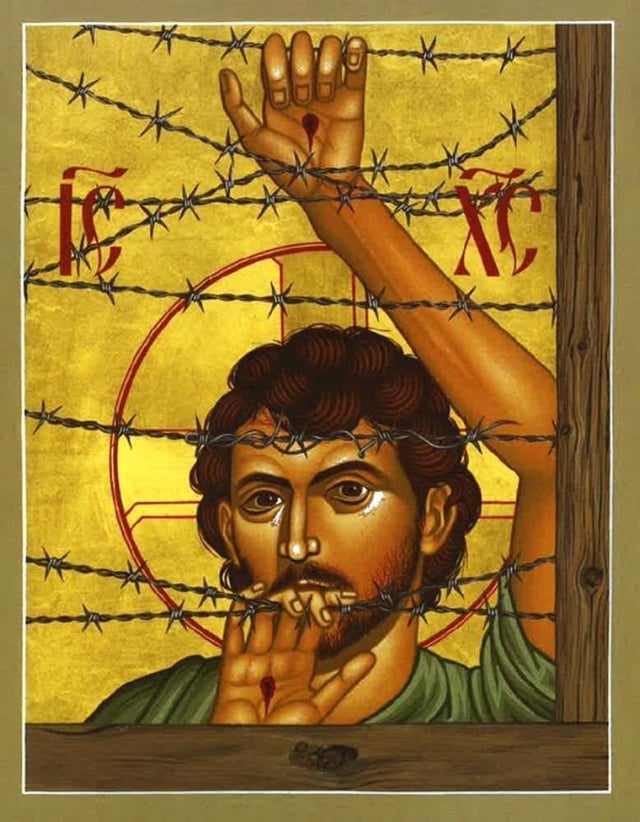
Julio, Executive Director of the Congregation Action Network (CAN), brought the Word. The work that CAN does is rooted in faith and the power of community. Guided by varied spiritual traditions, CAN brings congregations together across lines of difference to build solidarity, cultivate hope, and take collective action. As a Baptist minister and the son of Salvadoran immigrants, Julio sees his work as not only vital for himself, but personal. He says, “My faith informs my work. I see that newcomers to this country deserve to be treated with respect and compassion.”
Julio’s notes for his reflection on Luke 1:67-80 are below.
Advent: A time of waiting for the coming of Jesus, when things fall apart. This is our specialty.
We encounter a special couple Elizabeth and Zechariah.
The elderly Zecharia’s name declares “The Lord remembers,” has not forgotten God. And God has not forgotten them. Elizabeth’s name means “My God keeps His promises.”
Zechariah and Elizabeth’s Identity
- Zechariah: A priest from the division of Abijah.
- Elizabeth: Also from a priestly family, a descendant of Aaron.
- Both are described as:
- Righteous before God
Blameless in obedience
- Righteous before God
- Yet they carry a deep wound:
- Elizabeth is barren
- Both are very old (their hopes appear long dead)
- Shame
Zechariah a man worn by unanswered prayers, someone who has learned to protect a tender heart from another wave of disappointment.
Why do I like Zechariah? Many of us run from doubt, but countless times we are reminded that most of us are full of doubt and shame. He is human.
What makes Zechariah’s song is a powerful vision of what was and what could be—a vision and spoken with an infant in his hands.
He speaks this blessing while Rome occupies the land. While his people are oppressed. While his body is old and worn from waiting. And yet, standing with a newborn in his arms, he sings to a world is created anew.
His first line is a declaration of faith against despair:
“Blessed be the Lord God of Israel, because he has come to help and has redeemed his people.”
Not “God will someday help.”
But God has come. God is already moving. God is already here. There is a force greater than hate at work.
Hope is not denial—it is defiance.
He continues:
“He has raised up a horn of salvation… as he spoke through the prophets long ago.”
A “horn” in Scripture symbolizes strength—real, concrete power. God’s salvation is not abstract. It disrupts the world. It confronts injustice. It saves those “from the hand of all who hate us.” This is not a private spiritual comfort of prayer; rather it is a public action.
And then comes the heart of the prophecy:
“He has done this to show mercy… to remember his covenant.”
Mercy is God’s. When you show mercy you are reflecting God’s action in history. You are acting with God.
Zechariah calls us to know: Where human systems forget the marginalized, God remembers.
Where empires build order through fear, God builds community through mercy.
Zechariah then makes a turn—from proclaiming God’s action to naming the calling of his infant son:
“And you, child, will be called the prophet of the Most High… to give his people knowledge of salvation through the forgiveness of their sins.”
Imagine that moment. An old priest holding a miracle child, realizing that this boy will not be a symbol of comfort but a prophet of disruption. John will call people out of complacency. He will challenge corruption. He will speak truth so clearly that even kings will be unnerved.
His message: “Repent, for the kingdom of heaven has come near.” (Mt. 3:2)
Luke 3
10 “What should we do then?” the crowd asked.
11 John answered, “Anyone who has two shirts should share with the one who has none, and anyone who has food should do the same.”
12 Even tax collectors came to be baptized. “Teacher,” they asked, “what should we do?”
13 “Don’t collect any more than you are required to,” he told them.
14 Then some soldiers asked him, “And what should we do?” He replied, “Don’t extort money and don’t accuse people falsely—be content with your pay.”
In his song, Zechariah blesses him—not with fear, but with purpose:
“You will prepare the way. You will help people return to God. You will tell the truth with courage.”
Then Zechariah gives us a tender images of God’s in breaking Kingdom:
- It is not like ICE smashing windows
- Tearing apart families
- Masked people kidnapping our neighbors
- It is “Because of God’s tender mercy
the dawn will break upon us from on high
to give light to those who sit in darkness
and to guide our feet into the way of peace.”
Here is the center of Advent: a dawn—slow, gentle, inevitable. Full of purples and pinks. Not a light that blinds, but a light that guides.
A light for those who are stuck, those who are grieving, those who feel forgotten.
A light for people who have learned to live in the “shadow of death.” Those waiting for a ray of hope.
Zechariah is telling us:
God’s mercy is not distant.
It is in-breaking in like morning light.
And it is coming and WILL come especially for the ones sitting in darkness.
Finally, the passage closes with a quiet and powerful sentence:
“And the child grew, and became strong in spirit… in the wilderness.”
That is where we find ourselves in the Wilderness of Time.
Not in palaces or centers of power nor comfort.
But in places where God is the only compass.
Like Zechariah, we live in a world where fear is real, where injustice is heavy, where many sit in darkness. Yet this Scripture pulls us into a deeper truth:
- God remembers when the world forgets.
- God’s mercy arrives slowly but surely.
- Prophets rise from unexpected places.
- The dawn belongs to God, not to the empire.
And perhaps most importantly:
Our own voices—like Zechariah’s—can become instruments of hope after seasons of silence, loss, or doubt.
The invitation today is simple and profound:
Let God guide your feet into the way of peace.
Let God’s tender mercy break upon the parts of your life that feel dark.
And let your voice—reborn like Zechariah’s—speak blessing and courage into this weary world.
Amen.
“Into the Darkest Hour” by – Madeleine L’Engle
It was a time like this,
war & tumult of war,
a horror in the air.
Hungry yawned the abyss –
and yet there came the star
and the child most wonderfully there.
It was a time like this
of fear & lust for power,
license & greed and blight –
and yet the Prince of bliss came into the darkest hour
in quiet & silent light.
And in a time like this
how celebrate his birth
when all things fall apart?
Ah! Wonderful it is:
with no room on the earth,
the stable is our heart.
“Liam”
At church, my turn to read
The lesson from my beat up Bible,
(Presented to “Billy,” Oak Park
Sunday School, Philadelphia, 1949).
I recite that David defeats
The Moabites, executes two out of
Three prisoners face down in dirt
And praises the God we worship.
Afterwards I float from the bleeding
Altar, wondering what I am doing
Back here among the bloody Christians
Of my childhood.
A seven year old spirit,
Little suffering Liam the epileptic,
Appears from the pews.
A football helmet on his head,
His protection from daily seizures.
Liam hugs my knees hard.
Wordless.
I toss the Bible in a pew.
Now I know what I am doing
Back here.
“The Family Bible” by Bill Henderson Black Mountain Press
“Faith”
I wanted to be
An atheist
But I lost
My faith.
Zechariah’s Praise and Prediction
67 Then his father Zechariah was filled with the Holy Spirit and prophesied,
68 “Blessed be the Lord God of Israel,
because he has come to help and has redeemed his people.
69 For he has raised up a horn of salvation for us in the house of his servant David,
70 as he spoke through the mouth of his holy prophets from long ago,
71 that we should be saved from our enemies,
and from the hand of all who hate us.
72 He has done this to show mercy to our ancestors,
and to remember his holy covenant—
73 the oath that he swore to our ancestor Abraham.
This oath grants
74 that we, being rescued from the hand of our enemies,
may serve him without fear,
75 in holiness and righteousness before him for as long as we live.
76 And you, child, will be called the prophet of the Most High.
For you will go before the Lord to prepare his ways,
77 to give his people knowledge of salvation through the forgiveness of their sins.
78 Because of our God’s tender mercy
the dawn will break upon us from on high
79 to give light to those who sit in darkness and in the shadow of death,
to guide our feet into the way of peace.”
80 And the child kept growing and becoming strong in spirit, and he was in the wilderness until the day he was revealed to Israel.
Beloved siblings in Christ,
Grace and peace to you in this sacred season of Advent—a season that teaches us how to wait with courage, how to hope with defiance, and how to prepare for a God who draws near to those who suffer.
Advent is not sentimental.
It is not soft.
It is not passive.
Advent begins with a cry—of the Christ Child. At this point of human existence never had such power been in a form of true vulnerability—a baby in poverty and without protection of a nation state. In an age defined as Great, God chose to live among a stateless, poor and weak family. May that change the way we live. May this be the curative breath that blows new life into these dry bones of the Church in the United States.
If I were to name the church in 2025, I would call it the Pontius Pilate Church. This is the church that with great pride sets Jesus Barabas free and openly tortures and puts to death the people that Jésus de Nazaret identified with in the first century.
Advent Sermon: “A Child Crying Out in the Wilderness of America”
Beloved siblings in Christ,
Grace and peace to you in this sacred season of Advent—a season that teaches us how to wait with courage, how to hope with defiance, and how to prepare for a God who draws near to those who suffer.
Advent is not sentimental.
It is not soft.
It is not passive.
Advent begins with a cry—a voice in the wilderness saying:
“Prepare the way of the Lord.”
And today, that cry needs to rise again across this entire nation.
1. A Truth We Must Name: We Are Living in an Anti–Latin American Era
Across the United States, Latin American families—immigrant and U.S.-born alike—are facing a rising tide of hostility, violence, and political scapegoating. We are living in an era where:
- Brown bodies are profiled and criminalized
- Raids and detentions traumatize entire neighborhoods
- Families are separated with cold efficiency
- Migrants are treated as threats, not neighbors
- Refugees are dismissed instead of welcomed
We must say it clearly:
This is an Anti–Latin American era in the United States.
And it is happening, in part, because the faith community has been too quiet.
2. The Dangerous Vacuum Created by Faith Silence
In my advocacy work at the local, state, and federal levels, I have seen the consequences of our silence:
- Policies hardened
- Fear spread
- Cruelty became normalized
- Human dignity was eclipsed by political calculation
When the moral voice of the church retreats,
the forces of oppression advance.
And they have.
3. A Hard but Necessary Truth
Let me speak plainly—and pastorally—and prophetically:
I’ll be honest: I’m not seeing the smaller, local actions making the impact we need, especially as families and communities are being torn apart faster than we can respond.
We are doing good work.
We are doing faithful work.
But the scale of the crisis is outpacing our current responses.
The attacks upon our community are creating unlivable conditions for the most vulnerable.
And Jesus names these very people in Matthew 25—the hungry, the stranger, the imprisoned, the one fleeing harm.
He tells us that what we do to them, we do to Him.
This moment is calling for:
- Something bolder
- Something more coordinated
- Something more courageous
- Something more public
Something unmistakably rooted in the Gospel
In other words:
This moment is calling for the full moral voice of our faith leaders.
Not just gestures.
Not just statements.
But a movement.
4. Advent Reminds Us Who We Follow: Jesus of Nazareth
As we enter Advent, we remember that God chose to enter the world through a family who:
- were poor,
- displaced,
- brown,
- seeking refuge, and
- finding no room at the inn.
Jesus of Nazareth was born into vulnerability, not privilege.
He lived among the outcasts, the undocumented, the laborers, the widows, the imprisoned.
He chose the margins—and then called His disciples to do the same.
This was not accidental.
This was the Gospel.
And so we must ask ourselves:
If our faith does not stand publicly with the vulnerable today, what Jesus are we following?
5. Advent Is a Call to Courage, Not Comfort
John the Baptist stands at the start of this season shouting:
“Prepare the way of the Lord. Make His paths straight.”
To prepare the way today means clearing the path of:
- racist laws,
- militarized immigration systems,
- narratives of fear,
- and our own spiritual comfort.
Advent is an invitation to a courageous faith that refuses silence in the face of suffering.
6. A Call to the U.S. Faith Community: Rise and Speak
America needs a faith revival—not of sentiment, but of moral courage.
We need:
- Congregations stepping into public witness
- Faith leaders challenging every level of government
- Communities that ensure Latin American families never stand alone
The Gospel demands a faith that is public, protective, and prophetic.
God is asking the U.S. church:
“Where are you?”
“Whose side are you on?”
“Will your voice be louder than the forces of fear?”
7. The Promise of Advent
Advent reminds us that:
- Light appears where the world expects darkness
- Hope rises where the empire wants despair
- God comes to the margins first
- And no system of cruelty—not even an empire—has the final word
Advent is God’s promise that liberation begins in the places the world ignores.
God is still looking for people willing to prepare the way—
people willing to be a voice crying out in the American wilderness.
May we be that people.
May we rise as a community of courage.
May our Latin American siblings know—through our voice, our presence, and our action—that they are not alone.
Come, Lord Jesus.
Wake us up.
Shake us up.
And make us builders of your hope.
Amen.