Seekers recognizes that any member of the community may be called upon by God to give us the Word, and thus we have an open pulpit with a different preacher each week. Sermons preached at Seekers, as well as sermons preached by Seekers at other churches or events, are posted here, beginning with the most recent.
Click here for an archive of our sermons.
Feel free to use what is helpful from these sermons. We only ask that when substantial portions are abstracted or used in a written work, please credit Seekers Church and the author, and cite the URL.
A Sermon by Mike Tabor
 November 17, 2019
Twenty-third Sunday after Pentecost
Mike Tabor reflected on the agricultural origins of the yearly Jewish festival cycle. Using the diagram shown here, he pointed out that the Rosh Hashanah/Yom Kippur/Sukkot/Hoshanah Rabah group of observances in early fall as one of four “new year” observances that mark important moments in the agricultural cycle in the Middle East. The others include the late winter observance of Purim, which is similar in many ways to Carnival; the early spring festival of Pesach (Passover), which coincides with the barley harvest; and the early summer observance of Shavuot (Pentecost) at the time of the wheat harvest.
A Sermon on Sanctuary by Charlene Belsom Zellmer
November 10, 2019
Twenty-second Sunday after Pentecost
Rev. Charlene Belsom Zellmer, interfaith minister, key person in the Congregation Action Network (CAN), and the leader of the Sanctuary for Rosa team at Cedar Lane Unitarian Universalist Church, spoke on the Sanctuary movement, the current Supreme Court case involving DACA (Deferred Action for Childhood Arrivals), and her own experiences near the border in southern Arizona. The text of this sermon is not available.
“Open My Eyes” by Okima Bryant
November 3, 2019
Twenty-first Sunday after Pentecost
Never ever have I imagined that I would stand in front of any congregation to deliver any type of sermon, but the speed of the good Universe happens on its own time and here I am. Randomly, I chose November third to deliver my experience of Wise, VA to you, not knowing the lectionary, a word that I only learned of recently. (Thanks Pat!) Once I was finished reading Habakkuk, these words that spoke of, patience, and hope gave depth and meaning to how I view communities and Wise, VA.
In chapter 1, we hear the Prophet’s prayer 1:2 “O Holy One, how long shall I cry for help, and you will not listen? Or cry to Violence! And you will not save?”, and Habakkuk, 1:3 “Why do you make me see wrong-doing and look at trouble? Destruction and violence are before me; strife and contention arise.”
For most of my life, my solution to this was to simply turn off the TV, but that’s not a fix all. Now my spirit tells me, it is virtuous to witness these afflictions because we have an ethical role to stand up and speak for those whom are unwilling or incapable to act for themselves. SAMS (Southern Appalachian Mountain Stewards) along with others in similar mining areas speak for the mountains, streams, and lives within their communities.
“For All the Saints….” by Marjory Bankson
 October 27, 201
All Saints/All Souls/Day of the Dead
For All the Saints…
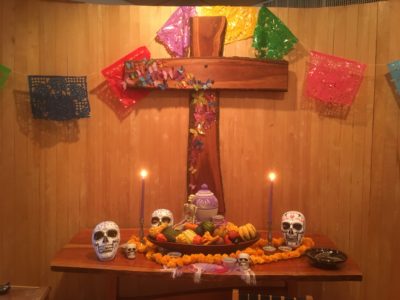
Today we are celebrating All Saints Day at Seekers, with a Day of the Dead altar, a burial urn on the bulletin, a tile on the Memory Wall for Emily Gilbert, and the Be-attitudes for a text. It’s quite a mash-up to deal with even before we include surrounding events, like the World Series and the latest presidential plundering of our public life. I’ll skip those for now.
I’m preaching as a member of the Living Water Mission Group. We have responsibility for the Memory Wall in the back stairwell, where you will find a new tile installed to remember Emily, who died this year at the age of 96. Emily was a founding member of Seekers Church, and a member of Living Water until she died. You will find the Memory Book open to her page in the Skylight Room after worship. This service is dedicated to Emily, and to all the departed saints who will be coming closer to us this week.
“What is Written on Your Heart?” by Deborah Sokolove
 October 20, 2019
Recommitment Sunday for Church of the Saviour Communities
The Nineteenth Sunday after Pentecost
I often preach during the recommitment season. As a follower of Jesus Christ and a member of a 12 Step fellowship, I recommit to turn my life and will over to God pretty much every day—indeed, sometimes multiple times every day. But I don’t think as often about my commitment to Seekers Church, so this season is an opportunity to reflect on what I am committing to as a member and a Steward in this community.
This is an important day in the life of this body, so when I signed up to preach today, I had not bothered to look at the readings because I knew it was Recommitment Sunday and that was what mattered. So I nearly laughed out loud when I finally did open the lectionary and discovered that the selections were like a giant wink from God. In the Gospel passage, Jesus tells a story about a person whose faithfulness in her pursuit of justice can be a model for us all. While that is pertinent, if you want to know what I’ve been thinking about the widow and the corrupt judge, you can read today’s Inward/Outward. This morning at Seekers, I’m going to talk about the Jeremiah passage, which talks about God’s renewed covenant with the Israelites.